Also due at Duxford next weekend was another French owned and registered 'warbird' the only flying Breguet Alizé. But as the IWM just posted on FB;
" We regret to announce that the 1050 Alizé will no longer be displaying at the Duxford Battle of Britain Air Show next weekend. While we always aim to deliver a full and exciting flying programme, aircraft participation is subject to a range of operational as well as logistical factors and subject to change. We’re continuing to work hard to bring together the best possible flying list for the show and look forward to welcoming you to IWM Duxford..."
Back in April though the Alizé Marine Association already announced the premature end of operations by its rare Breguet Br-1050 Alize ex-French Navy carrier-based anti-submarine warfare aircraft as reported on the European airshows website;
"..The Association Alizé Marine, owner/operator of the world’s last remaining airworthy Breguet Br-1050 announced that as of 30 April 2023, Alizé No.59 (F-AZYI) will be grounded. The Association is being forced out of its hangar at Nîmes Grande Provence Méditerranée airport by the municipal authority, which owns the airport and has not provided any alternative accommodation..[..] Alizé Marine will hold an extraordinary general meeting, at which it will consider the possibility of liquidation... "
Then in May Key Aero reported that the historic anti-submarine warfare aircraft had found a temporary new home. On 19 May, it was ferried to Base Aérienne 701 at Salon de Provence, where the French Air Force offered hangarage for a limited period. The Alizé appeared at the Patrouille de France aerobatic team’s 70th anniversary airshow the following weekend.
In a statement on Facebook, Alizé Marine added that, “for operational reasons”, it will probably have to move to Cuers-Pierrefeu airfield at “an undetermined date”, this being the location where numerous current French Navy aircraft types receive major maintenance. The association went on to say that it still hopes to negotiate “a permanent hangarage solution” back at Nîmes, where serial 59 — which has been flying as a civilian aeroplane since 2013 — was based during its active Aéronautique Navale career.
So there was a very good chance all along that the Alizé was not going to make it to the UK, which is a shame. For one, there are very few aircraft still flying powered by the Rolls Royce Dart. Having said that, the Breguet was at Le Bourget back in June, which is where I took this photo..
Just back from three weeks in Paris. And, yes, we went to the 55th Paris air show, the first since 2019 I think, due of course to Covid. It was packed with visitors and Paris itself was sweltering in a 36 C heatwave over the public weekend. As to the show, the 'best' day was the Friday when I got there early and was able to get through the gate without too much hassle while on Saturday the scenes of carnage to get in at the two gates 'L' and 'O' were incredible. I had the bright idea of trying to get into the show via the museum entrance - until some officious person with a scanner barred my way. No digital tickets at the museum entrance. Undeterred I went into the town and found a phone shop willing and able to print my 18 euro digital ticket out on paper from my phone! Friday was great but the crowds on Saturday made the whole experience rather unpleasant. And on Sunday I took the advice of a friend and stayed outside the perimeter fencing, heading instead to the car parks at the end of runway where I hooked up with a few other knowledgeable enthusiasts. There was a police presence here of course but standing slightly back from the fence we were not bothered by officialdom. Everything in the show took off and landed directly over our heads - providing a view of the flying display that was second to none and far better than being in the show, which was great!
And thanks to 'Tanguy' for putting up with my chat all afternoon!
Inside the airfield itself, there were lots of weird and wonderful contraptions on display ..and I don't mean the F-35. Some of them even flew, but the idea that we'll get 'real' electric planes worthy of the name is just pie in the sky in my humble opinion. I mean there were some electric craft flying - including the American Beta team which has decent range and endurance and everything else but still looks a long long way from being a 'useful' machine. Besides, the last person to design a machine that looked like a bird was Leonardo da Vinci! The Beta Technologies machine did recently become the first electric machine to fly into an airport in the New York/ New Jersey region. The company have also raised millions of $$$ in funding since 2017.
On my other blogs the French aviation press gets good coverage,especially given that noted author Jean-Louis Roba writes regularly for both 'Avions' and 'Aerojournal' - time to devote more coverage to that other regular on French news stands, 'Le Fana de l'Aviation'. A preview of coverage reposted from Le Fana's own site...current issue features the Mirage I - 'Dassault's master-stroke'. The first flight of a 'Mirage' with delta configuration took place on 25 June 1955. Engines were British Vipers.
Just posted on YT is this video on the Mirage IV. Starting his career in the Mystere, François Dubreuil, first flew the Mirage IV in 1975 and by the time of his last flight on the type in 1987 had accumulated nearly 2000 hours of flight time on the Mirage IV. Dubreuil knows this plane like the back of his hand and shares his 10 years of experience at the controls with us. Walking around the Mirage IV P number 11, François details its technical particularities - in-flight refueling, JATO takeoffs, the operation of the electric flight controls, the bombing profiles and the progress of a war mission....in the event that deterrence has failed.
If you can read French, former Armée de l'Air aviator Jean Houben has put together a site full of first person accounts from French airmen.
The Mirage IV was an aircraft capable of staying in the air for up to 15 hours at a time but which had a number of shortcomings. In "pipi room du Mirage IV" a former Mirage IV pilot describes the battle its pilots had with Dassault engineers to get some form of (necessarily) heated relief tube installed into the aircraft - pee freezes at -56° at subsonic speeds. Dassault said the equipment for this one function was far too costly and given the proximity of the radar and the radio altimeter to the 'outlet' were reluctant to incorporate one in the aircraft. Although a solution was eventually found there was no provision for the Mirage IV to be piloted by a lady pilot.
Much has been written and said about the French Air Force in the years immediately before the Second World War, much of it inaccurate. However, whilst the valour of their pilots cannot be underestimated, like many other continental countries France was unprepared for war, and this unpreparedness showed up in the quality and quantity of aircraft available to their air force. The good types that the Armée de l'Air had were not available in sufficient numbers to make any difference, as like many other countries the aviation industry was organised almost on an 'artisan' basis, unable to switch rapidly to full-scale industrial production when the need arose. And political inertia and interference also meant that time and effort was expended on a number of types that were not suitable for their intended purpose. The French government of the day eventually recognised this, and nationalised the aviation industry in 1937; even then, it was not brought under full-scale state control, thus leaving the nation unprepared for the Blitzkrieg of 1940. France was far from atypical in this respect. It is also a fallacy to think that the French aircraft industry had been 'devastated' by German occupation - a notion that rather conveniently draws a veil over the extensive French collaboration that went on with the Germans, especially in the aeronautical field.
Following the defeat and subsequent armistice in June 1940 the Vichy French authorities had very quickly opened negotiations with their new German masters. On the table was an offer to produce spares for German aircraft manufacturers and establish overhaul and repair facilities for aircraft operating from French territory and in so doing preserve industrial capacity in aviation and preserve employment and some of their manufacturing base in France. In making themselves useful to the Germans, they hoped to avoid all their workers being drafted east to work as 'Auslandarbeiter' in German aircraft factories. This offer was quickly taken up and led to the establishment of so-called Frontbetriebreparatur or FBR plants - advanced overhaul facilities. Junkers set up their FBR at Villacoublay south of Paris. With Ju 88s operating from no fewer than thirty eight aerodromes throughout France at the height of the Battle of Britain the French quickly gained a certain amount of expertise on this particular type. This was 'collaboration', albeit (one suspects and hopes) with a degree of nose-holding and possible tolerance of a degree of sabotage and back-pedalling, in the hope and expectation of better times to come. The Vichy Government thereafter concluded the so-called Wiesbaden Agreement with the Reich to bring the French aircraft industry fully into alignment with German production, with one aircraft or engine out of every three being retained for Vichy, the other two going to Germany. Certain types, such as the Messerschmitt Bf.108, Siebel Si.204 and Fiesler Fi.156 Storch were intended for wholesale transfer of their production to France. And indeed, even the Focke Wulf Fw 190 was intended for this move (and the post-war Armée de l'Air was briefly equipped with home-built Fw 190s, known as the NC.900). While some would argue that the French were not constructing war machines for the Germans, it is nonetheless the case that producing large numbers of transports and seaplanes enabled German industry to concentrate on fighters and other offensive weapons.
As the Germans were expelled from French territory during 1944, determined efforts got underway to re-establish the French aviation industry. As would be the case with other Allied nations, great interest was shown in all manner of weapons systems and aircraft produced by the aircraft manufacturers of the Third Reich. There was another motive for what was to follow - the parlous state of French industry and a total lack of foreign currency naturally led the French to want to seek to exploit the huge quantities of war materiel - spares, parts, tools and jigs - left behind by the retreating Germans. Their factories had produced hundreds of machines for the Germans (both German and French types, eg some 600 Caudron C.445 twins) and they had large stocks of German parts and equipment.
Thus it was that in 1944, the Liberation saw a French aircraft industry ready to move quickly into full-scale production to help rebuild the economy. And as a member of the Allies, France shared in the uncovering of German high technology aviation - and quickly took advantage of that opportunity to quickly produce home-grown examples of the new and exciting jet aircraft. Most of the German types that the French produced were obsolete. In the meantime their 'German' equipment was cost-effective and usually of reasonable quality. These were the reasons that led to the decision to use the Jumo 213 to power the SO-8000 - the British Griffon was too expensive to be imported. The S.N.C.A.S.O. ejection seat came directly from Heinkel. The Me 208 was due to go into series production in France - it did post-war as the Nord 1100 Noralpha.
However in the immediate post-war environment the French were now much more interested in trying to catch up with the new jet and jet engine technologies in which they lagged way behind. They were soon testing examples of the Me 262, He 162, Me 163 and appropriating German materiel and scientists just as the other powers were doing. It was not long before their own outlandish designs were flying, eg SO 6020, 4000, 6000, SO M2. The Arsenal VB. 10 (below) first flew in July 1945.
But the French penchant for "interesting" politics meant that this initial surge of innovation was quickly diluted as designers and factories turned out a bewildering variety of weird and wonderful shapes, both piston- and jet-engined. Some were successful; others were not. Some, like the Dassault MD.450 Ouragan, saw series production and service; others, like the Nord 1500 twin-engined torpedo bomber, were less successful - the Nord in part because its torpedo bay was too small for the torpedoes the French had access to at the time...
This 'special edition' of the French magazine 'La Fana de l'Aviation' tells the story of the six years following liberation and the bewildering variety of aircraft the French industry turned out. In a changing world, the aviation industry everywhere had a hard time keeping up, and France was no exception.
First flight of the Leduc ramjet carried aloft on the SE Languedoc 'mother-ship'
The Leduc ramjet prototype could not take off unassisted (ramjets cannot produce thrust at zero airspeed and thus cannot move an aircraft from a standstill) and was therefore intended to be carried aloft by a parasite aircraft mother ship, such as the four-engined AAS 01A & -B German-origin designs or the French-designed Sud-Est Languedoc four-engined airliners, and released at altitude. Following test flights of the AAS 01/Leduc 0.10 composite, independent unpowered gliding tests began in October 1947. After three such flights, the first powered flight from atop an AAS 01 mother ship was made on 21 April 1949 over Toulouse. Released in a shallow dive at an altitude of 3,050 m (10,010 ft), the engine was tested at half power for twelve minutes, propelling the aircraft to 680 km/h (420 mph).
In subsequent tests, the 0.10 reached a top speed of Mach 0.85 and demonstrated the viability of the ramjet as an aviation powerplant, with a rate of climb of 40 m/s (7,900 ft/min) to 11,000 metres (36,000 ft), exceeding that of the best jet fighters of the time.
Of the two 0.10s originally built, one was destroyed in a crash in 1951 and the other severely damaged in another crash the following year. Both pilots survived with serious injuries.
Generally similar to the 0.10, the Leduc 0.11 featured a Turbomeca Marbore I turbojet on each wingtip, to provide better control during landings. This first flew on 8 February 1951, but was converted back to 0.10 standards (and thereafter referred to as Leduc 010 n°03) a few months later after problems occurred, including misting of the pilot's windows, powerplant synchronization, and wing deflection caused by the turbojets. The engines were replaced by inert mass balances. This aircraft flew 83 test flights and is preserved at Le Bourget.
Photo taken at Querqueville, next to Cherbourg during August 1940. A selection of French naval air arm types displaying Balkenkreuze and possibly used as decoys.
Those a/c were used as decoys with fake German markings to be later "bulldozered" on to the nearby beach. All a/c are former French naval aviation types, 'left over' on June 18 1940 when the station was evacuated. The reverse of the photo is marked " Lockvögel auf FF Platz Querqueville Aug. 40". The German word "Lockvogel" (plural Lockvögel) means decoy.
From L to R :
Two Potez 631 (ex F1C) MS 406 (ex Armée de l'air, evacuated from Calais by Lt Habert of AB4 squadron), two Dewoitine 376 (ex F1C), one Loire-Nieuport 401 or 411 (ex F1A), Potez 567 (c/n n° 9), Levasseur PL.7 (station "hack"), Potez 631 (ex F1C)
Frenchman Jules Védrines was a popular and populist aviator noted for a variety of stunts and record-breaking feats. Born 29 December 1881 in St Denis/Paris he obtained his 'brevet de pilote' in 1910. During the First World War he was largely involved in clandestine missions, landing behind enemy lines to drop or pick up agents. At the start of the war although a 'civilian' aviator he was mobilised. He was one of the first aviators to fly 'armed' sorties although his lack of military discipline soon saw him sent away from the front! His armoured Bleriot monoplane aircraft was named La Vache (The Cow) and was emblazoned with a picture of a cow, in homage to his family's roots in the Limousin region - or alternatively 'la vache' is a mild French expletive and starting the engine generally involved a bit of effort and swearing!
It was designed for attacking balloons and airships and for ground strafing of troop concentrations..
On 15 July 1915 Védrines was mentioned in the French Army Order of the Day for his work with the Sixth Army, for whom he had flown over 1,000 hours on reconnaissance missions.
"... the winner of the Paris-Madrid (air race of 1911) has built a new monoplane and has given it a very symbolic name ( 'La Vache - a word that has a double meaning in French; the 'cow' or an exclamation 'blast it'), an indication that the popular aviator will once again pull off an act of bravoure as nothing is above his courage.."
Screen captures from rare ina.fr footage depicting Dewoitine test pilot and pre-war aerobatic champion Marcel Doret - here briefing his pilots in the lighter overall - leading a small unit of Free French Dewoitine D.520-equipped pilots supporting the assault on German 'Atlantic pockets' following the liberation of France during late 1944. Established as early as July 1944 'Groupe Doret' was a FFI fighter unit (Forces Francaises de l'Interieur) formed in south-western France at Tarbes-Ossun ( an 'escadrille' under former Morane Saulnier chief pilot Cliquet) making use of stocks produced for and abandoned by the retreating Germans. In Toulouse especially stocks of some forty machines were hangared and these could quickly be made flight worthy. A second 'escadrille' was thus established at Blagnac under SNCASE chief pilot Galy (Duny and Cuny 'Le Dewoitine D.520'). Apparently Cliquet flew the first sortie on 24 August 1944 in D.520 No. 526. While these machines had no aerial adversaries to contend with their missions consisted of training and recce flights as well as attempting to 'neutralise' German flak positions in and around the 'Atlantic pockets' where large contingents of German forces were holding out. Between 16-19 October the Doret D.520s escorted Dauntless dive bombers operating over Royan and la Pointe de Grave.
This 367-page hardback published in 2003 is another book that I would like to own but probably never will. As advertised by Rich Carrick and sold by him on ebay.
" ..Superb volume! Highly detailed and complete down to the smallest detail. In short, a reference book for all aviation enthusiasts! Many rare photographs - absolutely fantastic reference for modellers and aviation fans. Naturally, the book is entirely in French, but if you have a basic understanding of the language you should be fine. The photos speak for themselves. There are also detailed scale plans. Very hard to find, even in France, and can command huge prices!.."
photo sortie by Ewan Lebourdais from the base aéronautique navale (BAN) de Lann-Bihoué, Lorient - shared with the photographer's permission.
" Et voila quelques photos réalisées avec la 23 F de l' Aéronautique Navale - 100 000 vues pour la vidéo, merci à vous, c'est un bon début :-P Fier de cette mission de rayonnement par la photo artistique pour la Marine Nationale !! Partage autorisé - plus de renseignements sur www.ewan-photo.fr"
More on the Atlantiques of Flotille 23 F here French text)
Jean Copponnex flew both the Mirage III and IV during the Cold War with the Escadron de Bombardement 3/94 'Arbois'. During September 1973 a detachment of three Mirage IV A nuclear bombers are in Solenzara, Corsica, for their annual training week practising high speed low altitude weapons delivery - crews were tasked to drop one mock-up AN 22 nuclear free-fall bomb using the LADD (Low Angle Drogue Delivery) procedure, releasing the bomb while pulling up from low altitude to roll out and down and accelerate at high speed away from the drop zone while the bomb itself is braked by parachute. With a TOW of some 25 tonnes (10 tonnes of fuel) Copponnex gets airborne on the afternoon of Wednesday 26 September 1973 in 'clean' ('lisse') configuration (no drop tanks). During his second approach run he experiences an engine failure at well over Mach 1 off the coast of Corsica. The aircraft quickly becomes unrecoverable and less than two minutes after the first 'oil 1' warning light flashes up on the dashboard and stays lit, both pilot and navigator have ejected from their aircraft - Mirage IVA n°2 AA. An interesting account...
".. I informed 'Jack', my navigator, of the failure, and applied my procedure which was very straight forward and clear-cut - throttle back the defective engine (to avoid any possible further deterioration) and go to full throttle on the other while radioing in our problem. While infrequent, this type of failure was not unknown and we trained for it of course. Now we had to get the aircraft back to the airfield - we were at low altitude and high speed some five nautical miles from home...the only manoeuvre possible to accomplish this was a wide starboard turn while climbing to just below the cloud base - there was no question of losing visual with the ground - while slowing to 250 kts to prepare for landing.. ..however I was suddenly unable to light the after-burner on the starboard engine. Our speed continued to fall away ..alarmingly. Checking the fuel circuit I twice -tried - to relight the afterburner in the starboard engine ...while letting out a 'ca merde!' ( " its going tits up!"). Nor could I relight the port engine that I had just shut down. At 600 ft and 300 kts, we were reaching the limit of the capabilities of our Martin Baker seats. I ordered the ejection. Two minutes had past since the first alarm. Immediately the navigator's seat 'took off' leaving me free to pull the lower handle. While not an 'emergency' at the outset, subsequent and successive failures demanded a quick and clear decision. I had Jack to thank for acting quickly and unhesitatingly. I had barely shouted out 'jump' than I heard the explosions detonating the canopy glazing and the two cannon 'shots' propelling his seat out of the fuselage. He told me later that he already had his hand on the handle as he heard me let out my expletive - had he hesitated, I'm not sure that I would have had time to jump in turn..at moments like that you can't afford to ask yourself, 'have I done the right thing?', 'where have I gone wrong?' or even, 'I'm going to have account for my actions here'. Too many pilots haven't had the good fortune to act quickly, preferring to stay with their aircraft, hesitating over or delaying a decision. For a pilot, carrying out an ejection is anything but a 'normal' decision. - you take off, you bring the aircraft safely back to terra firma... As I drifted down under the canopy that had safely deployed, I was treated to the breath-taking spectacle of 'my aircraft' plunging into the sea in an enormous fountain of spray.."
More Armee de l'air pilot accounts on this blog;
"JAGUAR SUR AL JABER" by Alain Mahagne, former Jaguar pilot of EC 2/11 Vosges, the only French pilot to be injured on operations in the first Gulf Air War, Jaguar sur Al Jaber is a 127-page account of flying the Jaguar in combat. Mahagne describes his sortie flown on 17 January 1991.
Despite the nationalisations of the Front Populaire during the mid-1930s, French industry was still manufacturing fewer than 100 aircraft per month during the period late 1938 to early 1939. The output from all French aircraft factories in total per month during early 1939 amounted to far less than the output from a single German producer. But by August 1939, France's aviation industry was beginning to shake off the shackles of obsolescence - although aircraft factories still closed for the weekend break, in some cases even after 10 May 1940. So the process of modernisation was still moving only at snail’s pace. On the out-break of war in September 1939 the Armée de l’Air’s entire fleet of aircraft was still essentially out-dated, including its most modern fighter, the Ms 406.
In an effort to make up the shortfall the French placed huge orders for foreign types. Most significant of these were the American Curtiss Hawks (H-75).
Above; the port fuselage side of the Curtiss H-75 restored to flight by the Fighter Collection at Duxford representing H-75 A1 N°82 as seen on a period photo taken at Villacoublay during July 1939. Note the riveted finish characteristic for a fighter aircraft of late-thirties vintage, some way removed from state-of-the-art for a WW II fighter. Below; the starboard fuselage side is finished in the
markings of a 3rd escadrille GC II/5 fighter as seen in 1940 complete with Sioux
emblem, also the emblem of the Fighter Collection.
The French pilots were enthusiastic about the American fighter - here was a (relatively) fast, maneuverable machine that didn't leak oil or hydraulic fluid, whose cockpit was comfortable and well-appointed and whose brakes worked! Many converted straight from the elderly pre-war open-cockpit Dewoitine monoplane fighters.
In September and October 1939 both the Curtiss Hawk and the MS 406 fighters (800 hp engine) still held the edge over the Me 109 Ds (700 hp engine) they met in combat. In one of the most celebrated encounters of the Phoney War three flights of GC II/5 ran into the Messerschmitt Bf 109 D fighters of JGr. 102. The highly manoeuvrable Curtiss fighters secured a number of victories duly feted in the French media as the battle of the « the 9 vs. the 27 ». At least one French source claims that the Doras were led in the air by the leading Luftwaffe ace at the time, Maj. Hannes Gentzen. From November 1939 the Luftwaffe introduced the Emil variant of the Bf 109 (1,000-1,100 hp engine with the advantage of fuel injection), which was clearly better in the air and immediately worried the French. However the 109 E was introduced only progressively. Deployed only from the spring of 1939 on, production was very slow. The 109 D was still widely used at the end of 1939 and at the beginning of 1940. Both France and the UK raised their fighter production frantically and soon overtook Germany. The French 'equivalent' of the 109 was the D.520 but when it finally came into service -like most new French aircraft being introduced into service during early 1940 – it suffered considerable teething problems. As it was the first D.520s only went into service in mid-May 1940 with GC I/3 who managed just 75 victories during the campaign May-June 1940, a long way off the top score for French fighter groups. "..C'est la barbe, ces avions inexpérimentés.." – what a pain these unproven aircraft are!. .." (see Avions magazine Hors série 14, GC I/3 "Les rois du D.520..").
Below; excerpts from the 50-page RAE report of the comparison flights flown at Boscombe Down with a French Hawk during the winter of 1939-40 against the Spitfire and Hurricane..while the type was a lot slower than a Spitfire I ( and thus the Bf 109 E) it was very manoeuvrable - as Lionel Persyn put it in his monumental history of the H-75, " ..it could not hunt, but when hunted it could bite back..."
Why does the Hawk H-75 have such a relatively poor reputation? Lionel Persyn in his summing up says;
".. the H-75 may have been the plane of the French aces but it was also the plane of defeat. "
Whereas of course a comparable type -the Hurricane for example ( in close collaboration with the Spitfire ) - was the plane of victory.
The Hawk performed relatively well over France - but during the Westfeldzug the Germans were flying a lot more low level missions in support of the ground troops in France, than, say, they were during the Battle of Britain. The low altitude engines of the Hawks (and the two speed Cyclone wasn't any lower than the DB 601) may not have been a large disadvantage in France. There are a lot variables between the the Battle of France and the Battle of Britain including perhaps pilot experience/training and the average height of combat. Expecting the Hawk to do as well over England where, in general, the altitudes were higher and there were fewer 'tactical' aircraft flying may be a different story.
During 1939–1940, French H-75 pilots claimed around 230 kills (although the oft-quoted total of over 1,000 victories by the French Air Force during the 1939-40 time period is exaggerated). Losses were just 29 aircraft in aerial combat. While making up only 12.6% of the French Air Force single-seater fighter force, the H-75 accounted for almost a third of the victories during the 1940 Battle of France. Of the 11 French aces of the early part of the war, seven flew H-75s. The leading ace of the time was Lieutenant Edmond Marin la Meslée with 15 confirmed and five probable victories in the type. On 12 May 1940 the Curtiss H-75s of GC I/5 ran into the Junkers Ju 87 B Stukas of 1./StG 76 south-west of Sedan and claimed as many as 11 shot down in air combat - this happened in the locality of Bauillon-Ste Cecilé-Poury St. Remy. This may well have been the first time that the Stuka´s 'vulnerability' was demonstrated in large scale air combat. GC I/5 was as close as the Armée de l'Air had to a crack unit - claims for six Stukas, plus 12 more probably destroyed, were filed following this action by the five French pilots including Marin-la-Meslée, Sous-Lieutenant Jean Rey, Sous-Lieutenant François Perina, Sergent-Chef Dominique Penzini, and Sergent-Chef François Morel.
Some of the claims were as follows;
1./StG76 Junkers Ju 87 B-1. Shot down by Curtiss H-75s of GC I/5 in action south -west of Sedan 8.30 a.m. Crash-landed and burned out behind German lines east of Bouillon. BF Uffz Richard Kny badly wounded, FF Lt [ ] Haller unhurt. Aircraft 100% write-off.
1./StG76 Junkers Ju87 B. Badly damaged in attacks by south-west of Bouillon 8.30 a.m. Belly-landed near Bellevaux. BF Fw Friedrich Petrick badly wounded in stomach, FF Oberlt Wolfgang Unbehaun unhurt. Aircraft S1+KH 15% damaged but repairable. On return to base, radio contact was established with 'Zaratza' Unbehaun by the Staffelkapitän, Oberlt Dietrich Peltz, who picked up the crew by Storch within the hour.
2./StG76 Junkers Ju87B-1. Engine badly damaged in attack from below by Curtiss H-75s of GC I/5 during sortie east of Sedan and crash-landed in the Semois valley at ‘Les Longs Champs’ outside Dohan, east of Bouillon, 9.00 a.m. BF Uffz Helmut Gäth badly wounded in chest – died shortly after landing, FF Lt Heinz-Georg Migeod unhurt. Aircraft S1+MK 50% damaged but repairable. Helmut Gäth was originally buried in a field grave in an orchard off the Route du Sati on the north-eastern approach to Dohan. He now lies in Noyers-Pont-Maugis Cemetery, Block 3, Grave 1835.
2./StG76 Junkers Ju87 B. Returned damaged by Curtiss H-75s of GC I/5 during sortie east of Sedan 8.30 a.m. BF Gefr Ludwig Kirner slightly wounded, pilot unhurt.
Two Czechoslovak members of GC II/5, from left Sgt. František Chábera (pilot) and mechanic Cpl. Chef Vilém Nosek standing in front of the Curtiss H.75 N° 58, white "1", Toul-Croix-de-Metz, May 1940.
Photo: Pavel Vančata collection.
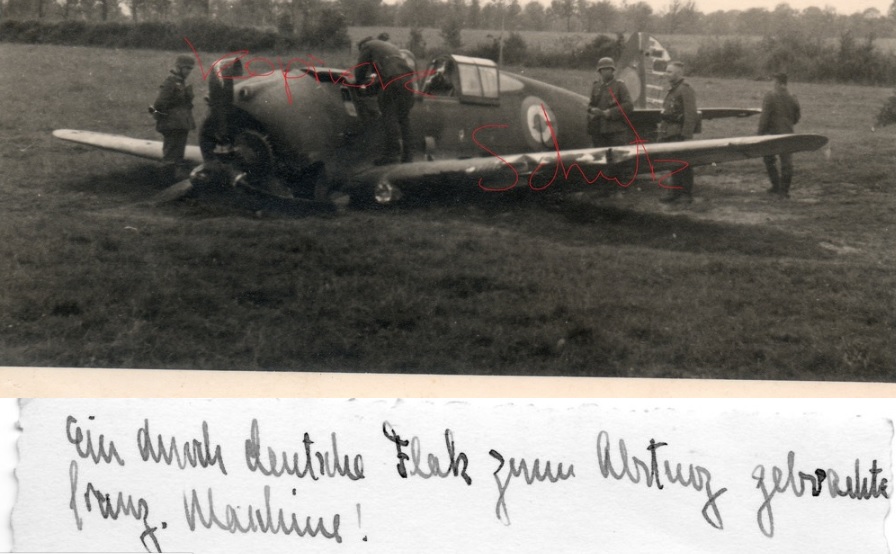
Below; " French machine brought down by anti-aircraft fire .."
French aviation blogger "Drix" is more scathing about the "Curtiss", as the French usually refer to the H-75;
" the qualities of the Curtiss have been largely overestimated - it achieved what it achieved thanks the high quality of the French aces that flew it.."
This is a reference of course to Accart, Marin la Meslée of GC I/5, top scorers in the Battle of France. GC II/5 appears to have been the only group to fly the Wright-engined Curtiss fighters on combat operations over the anchorage at Mers el-Kébir. S/Lt Trémolet (N° 2) and S/C Gisclon (N° 7) clashed with Skuas over the harbour on 3 July 1940. When Ark Royal's Swordfish attacked the Dunkerque for a second time on 6 July Gisclon claimed a Skua downed after a long dogfight, but although shore-based witnesses confirmed the 'kill' all of Ark Royal's aircraft returned safely..