Showing posts with label Ukraine- Russia war. Show all posts

Saturday, 25 July 2026

Ukrainian F-16 did shoot down a Russian Su 35


A Ukrainian F-16 did shoot down a Russian Su 35 with an air-to-air missile last month. U.S. General Dan Caine, Chairman of the Joint Chiefs of Staff, formally acknowledged the milestone air-to-air engagement during a congressional hearing. The German newspaper Bild first reported that a Ukrainian F-16 shot down a Russian Su-35S fighter jet in an aerial ambush aided by a Swedish-donated Saab 340 AEW early warning aircraft. This historic first air-to-air combat kill by a Western-supplied F-16 is now confirmed by Caine. 

 Initially reported by Bild and the Ukrainian Air Force as taking place on June 7, 2025, near the border in the Kursk/Sumy sector, roughly 42 kilometres behind the front lines. Reports indicated a Swedish Saab 340 airborne early warning radar platform tracked the Russian jet and fed target coordinates to Ukrainian F-16s for a beyond-visual-range strike.Dutch-modified F-16 AMs were first received by the Ukrainians in May 2025. The Saab 340 AWACS platform, taken on charge just a few months ago, reportedly detected the Russian aircraft 200–300 kilometers from the border and relayed targeting data in real time to the F-16. Once within range, the Ukrainian fighter launched an AIM-120 missile. The Russian Su-35 was shot down approximately 16 kilometres inside Russian territory, near the town of Korenovo in Kursk region.


Below; Ukrainian Air Force photo of one of their recently acquired F-16s. Load comprises AIM-120C AMRAAM and AIM-9L/M missiles, underwing fuel tanks, plus Terma (Adaptable Capability Enhancement) weapons pylons.

Wednesday, 17 September 2025

Ukrainian Zlin crop-duster carrying air-to-air missiles


From the 'Ukrainian News' FB page

 "..Ukrainian Crop-Duster Turned Drone Hunter. A Ukrainian tractor driver has captured rare footage of a Zlin Z-137T AgroTurbo agricultural aircraft — normally used for crop spraying — now modified to intercept and destroy Russian UAVs. The plane has been fitted with R-73 short-range air-to-air missiles, turning a civilian workhorse into an improvised air defense asset.This innovative adaptation reflects Ukraine’s ongoing ingenuity on the battlefield, where every available resource is re-purposed to counter Russia’s relentless drone attacks.."


From the Eduard Info page;

 ".. one option [ for combatting increased numbers of Russian drones..] is to give light aircraft the ability to strike Russian Shahed drones from a greater distance. This is how the agricultural aircraft of Czech (or Czechoslovak) origin, the Z-137T, has appeared in Ukrainian skies. It is a successor to the famous family that began with the Z-37 Čmeliak (Bumblebee). The aircraft was captured on a short video. It sports green-grey camouflage and two white stripes on the rear fuselage, which are the Army Aviation markings. Under the centre section, there are two additional fuel tanks, and two R-73 missiles under the wings. At the location of the missile pylons, two dark bands are visible encircling the wing, apparently reinforcements of the skin. The R-73 missiles use infrared guidance with a range of 30 to 40 kilometers depending on the version. On the Z-137T they are mounted on AKU-73 pylons. The aircraft itself has no radar or other equipment for targeting drones. The pilot must therefore be guided into the proper area by a ground control station. From there the missile takes over, being fully autonomous and able to find the target on its own. For this, however, it requires electrical power. It is therefore likely that the Z-137T has been fitted with an additional generator for this purpose. Voices were raised questioning the authenticity of the video on the grounds that the Z-137T lacks standard camouflage and the blue-yellow identification markings used at the front. It can only be said that none of the known photos of Yak-52 aircraft show a standard camouflage pattern either. They usually retain their original civilian paint, and some have even sported attempts at the wild camouflage schemes. The blue-yellow identification elements required in the combat zone are carried sparingly on Yaks as well, usually on the rudder only. These light aircraft do not operate near the frontline, but rather fight Russian drones in the interior..."


Tuesday, 2 September 2025

ВКС России получили четвёртую в 2025 году партию истребителей Су-35С - Russian Air Force accepts another 'batch' of Su-35S


The Russian Air Force has just received the fourth batch of Su-35S fighters this year. PJSC United Aircraft Corporation (UAC, part of Rostec State Corporation) announced on August 21, 2025 that it has handed over the next batch of new Su-35S multi-role fighters to the Russian Air Force. The 4++ generation aircraft passed a full cycle of factory tests, were accepted by the technical staff and tested in various operating modes by pilots of the Russian Ministry of Defense.
One of a batch of new Su-35S fighters built by the Komsomolsk-on-Amur Gagarin Aviation Plant (KnAAZ) of the United Aircraft Corporation, which were handed over to the Russian Air Force in August 2025. The onboard number is obscured (c) United Aircraft Corporation PJSC

UAC announced the transfer of the first batch of Su-35S fighters to the Russian Air Force in 2025 on March 29, 2025, the second batch on May 12, and the third batch on June 25. As usual, UAC reports from 2022 onward do not disclose the number of aircraft delivered, and the fighter aircraft's flight numbers are retouched on the official photos and videos distributed.The third batch handed over on June 25 reportedly consisted of three aircraft. According to "bmpd" on LiveJournal, during 2024, KnAAZ transferred four batches of Su-35S fighters to the Russian Ministry of Defense with a total estimated number of 15 aircraft. Presumably, the now transferred Su-35S fighters are manufactured under the additional (fifth) contract signed by UAC for the supply of Su-35S aircraft to the Russian Ministry of Defense. In total, taking into account previous contracts, the Russian Air Force has received an estimated 135 serial Su-35S fighters between 2012 and the end of 2024.


Tuesday, 8 July 2025

Baykar Bayraktar Akinci in Paris


Turkish defence company BAYKAR were showing off their Bayraktar Akinci drone in Paris. Akinci is a high-altitude long-endurance (HALE) unmanned combat aerial vehicle (UCAV) that first flew in 2019 and entered service with the Turkish Armed Forces on 29 August 2021. 

The aircraft has a 5.5+ ton maximum takeoff weight (MTOW), of which over 1,350 kg (2,980 lb) is payload. Akıncı is powered by two turboprop engines of either 450 hp (460 PS; 340 kW) or 750 hp (760 PS; 560 kW) and is equipped with electronic support and ECM systems, dual satellite communication systems, air-to-air radar, collision avoidance radar, and advanced synthetic-aperture radar. It is apparently the first UAV capable of launching a cruise missile. 

On 7 July 2021, Bayraktar Akıncı set an altitude record by cruising at 38,039 feet (11,594 m) for 25 hours and 46 minutes covering a distance of 7,507 km. On 10 July 2021, Bayraktar Akıncı conducted a 13 hours and 24 minute long flight with a 1360 kg payload. During the flight Akıncı was equipped with the NEB bunker buster bomb developed by TUBITAK SAGE, making it the heaviest bomb ever carried by an UAV.


Thursday, 5 June 2025

Operation Spider's Web - Ukraine's drone strikes on Russian airfields


The more you read about this operation the more incredible it appears -  117 drones transported -by duped Russian drivers in special containers - to within close proximity to four widely dispersed Russian long-range aviation bases and then commanded - via the Soviet's own telecoms networks -  to go and seek out some of the Russian strategic bomber force, potentially wiping out up a third of it. A master-stroke of asymmetric warfare. According to Ukraine's SBU security service the 01 June 25 drone attacks on four of Russia's long-range aviation hit :

34% of strategic carriers of cruise missiles at the main airfields of the Russian Federation .

34% hit claim by Ukraine= ~44–48 aircraft damaged or destroyed. 

Estimated total Russian strategic bomber fleet: ~130–140 cruise missile-capable bombers.
 
Tu-95MS: ~50–60 total (22–27 active; some reports mention 45 older variants).

Tu-160: Fewer than 20 operational.

Tu-22M3: ~60 in service (40 recently observed at Olenya airbase).


Russian Bomber Losses from Ukrainian Strikes

Tu-95MS Strategic Bombers
Dec 2022 (Engels-2): At least 1 damaged
Apr 2024 (Engels-2): 3 bombers hit
Jun 2025 (Operation “Spider’s Web”): Included among 40+ aircraft hit (exact number unspecified)
Minimum confirmed: 5 x Tu-95M

Tu-22M3 Strategic Bombers
Dec 2022 (Dyagilevo): At least 1 damaged
Aug 2023 (Soltsy): 1 destroyed
Jun 2025 (Operation “Spider’s Web”): Included among 40+ aircraft hit (exact number unspecified)
Minimum confirmed: 2 x Tu-22M3


Many of the Tupolevs in the drone footage appear to have literally piles of rubber tyres distributed across their upper surfaces. Is this to tell US satellites they're unserviceable or similar?  If so, then the Ukranians have wasted their time on a few of these decrepit airframes.  Or do they disrupt radio waves or similar? 

Edit - it seems that the tyres are to break up the outline of the aircraft so that the drone can not recognise it as a target.....but then that doesn't make sense..these bases were 1000s of kms from Ukraine. They weren't expecting to be attacked by drones..


An assessment of  the losses as seen in the video footage was posted by Tom Cooper on his ACIG.INFO board

- 8 Tu-95MS, nearly all FMC-examples (or 'fully mission capable'). Including RF-94132/Voronezh, RF-94127/Vorkuta, RF-94257/Chelyabinsk (one of last two Tu-95MS' manufactured)... (two 'probables' are RF-94117/Izborsk, and RF-94120/Kozelsk). At least three loaded with Kh-101s (AFAIK, the Russians run out of Kh-555s).

- 13 Tu-22M-3: I would say: 2-3 haven't been flown in some time, but the rest is 'legitimate'.

- both of the A-50s which are old, stored airframes. This was a waste of effort.

Still, now it can be said that this is nearly '100% of FMC-part' of the Tu-95MS-fleet, and something like 50% of all the Tu-22M-3s 'still operational as of the last two years' (i.e. well beyond the '30% of the Russian bomber fleet', originally claimed by the SBU).

...and the destruction of (at least) some 6-12 Kh-101s is also 'great news', because the Russians have major problems just with trying to make these. So, this attack blew up 'quite a stock': something like 'half a month of air strikes on Ukraine'. 

summary above by Tom Cooper


Wednesday, 17 January 2024

Russian A-50 AWACS downed over the Sea of Azov, January 14


" ..a couple of days ago Russia lost an A-50 and suffered damage to an Il-22 as widely reported on all news outlets (during the evening of January 14). Both of these aircraft are very valuable for the Russian Aerospace forces (the VKS) and there is some debate as to what exactly happened. ( Both Ukrainians and Russians claim to have downed the aircraft, although social media seems to be giving preference to the Russian story that this was a case of 'friendly fire'!) There are apparently some intercepted radio coms that allegedly originate from the Il-22 that specify that it is asking for assistance and that is is coming in for an emergency landing with photographs showing considerable shrapnel damage to the tail fin and tail plane. These aircraft are exceptionally valuable to a force and that's why usually there's only a few of those available and that's the case here as well with the A-50. Around 40 were built but Russia operates less than 10..While there is little hard evidence it would appear that these machines were targeted by Ukrainian Patriot missiles..."  Military Aviation History channel on youtube


Saturday, 2 September 2023

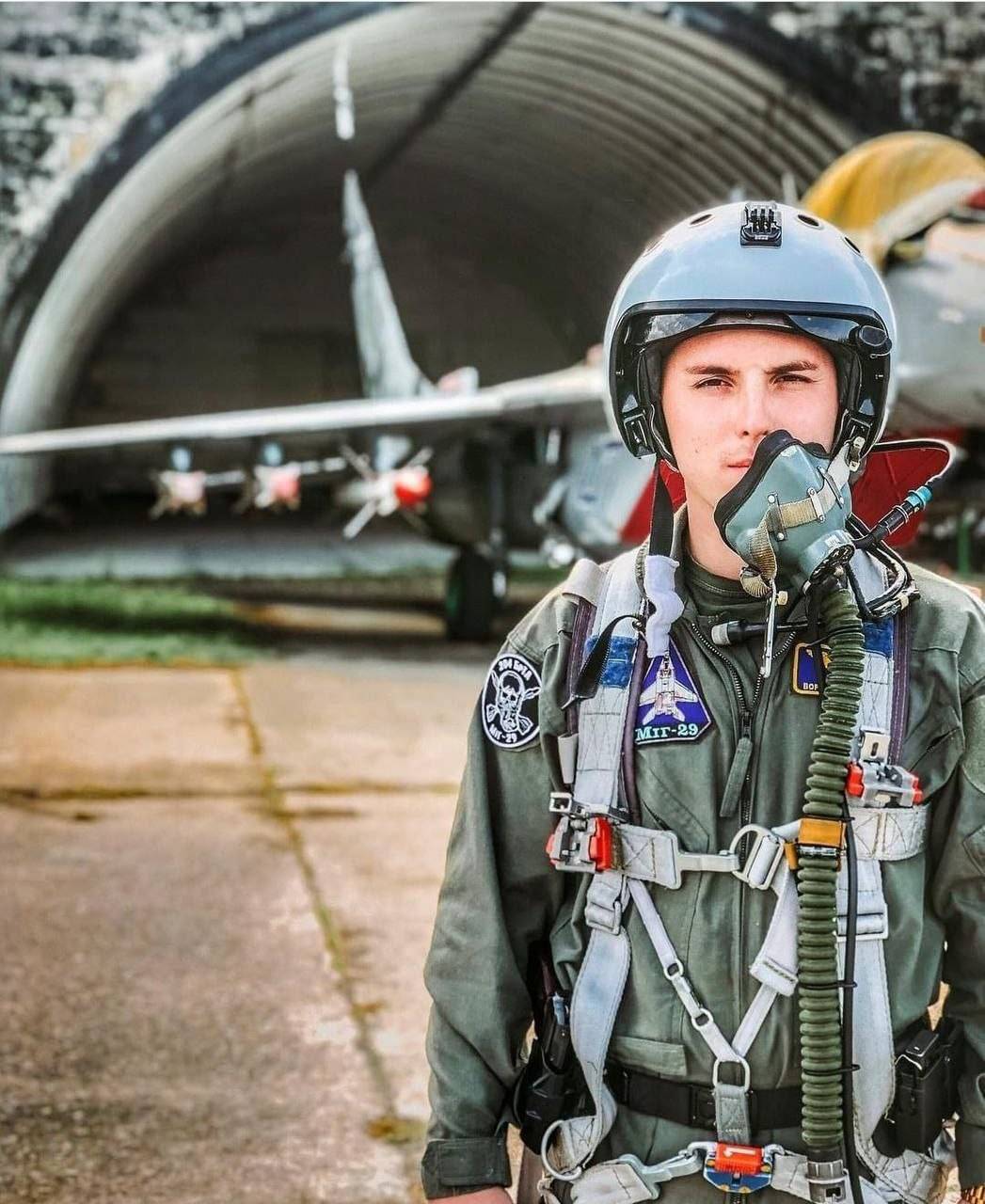
Ukranian AF 'drone-killer' Maj. Vadym Vorochylov, call sign 'Karaya 1'


Ukranian fighter pilot Vadym Oleksandrovych Vorochylov - call sign 'Karaya' - in front of his 204th BrTA MiG 29 'blue 47' armed with R-73 and R-27R air-to-air missiles. 

 A 'star' of Western media outlets Vadym Oleksandrovych Vorochylov was born on 2 February 1994 at Kremenchuk, south-west of Poltava. A graduate of the Ukranian air force national academy 'Ivan Kojedub' in 2016 he was assigned to the 204th Tactical Brigade (204 brihada taktichnoyi aviatsiyi or BrTA, tactical aviation brigade) in Kulbakino and from 2018 in Lutsk flying the MiG 29. In 2020 he earned the homour of 'best Ukranian fighter pilot' but in June 2021 he resigned after his short service commission of five years, citing as one of his principal reasons in an article in the Kyiv Post newspaper the lack of flying hours in the UkAF - between 35-80 per year- as compared to the NATO standard of around 180 hours (including 40 on simulator) and his low salary (the equivalent of around 750 euros/month)

With the launch of Putin's 'special military operation' on 24 February 2022 Vorochylov immediately rejoined the 204 BrTA with the rank of Major. According to various internet sources his unit comprised just 22 aircraft - 16 single-seat MiG 29s, including 'blue 07' and 'blue 08' (MiG 29 MU 1 'modernised'), four twin-seat MiG 29 UBs and two training Aero L-39s.

After sustaining heavy losses - including that of Maj. Yevgeny Lysenko on 9 March - the MiG 29s were removed from operations over the front lines and tasked with defending Ukranian territory from Russian cruise missile and drone attacks which became a virtually nightly feature of the war. The Iranian Shahed-136 drones in particular were almost impossible to bring down for Ukranian anti-aircraft defences, being too small and too slow with their low 'thermal' signature and small radar cross section - explosive charge 35kg, range 1000 kms, speed 185 km/h. At night the drones were impossible to detect visually, especially from the cockpit of a MiG 29. On 5 October 2022 the MiGs of the 204th brought down their first three Shahed drones.

On 11 October Vorochylov downed his first two drones and a further three on the following morning. That evening Vorochylov was again airborne and brought down his fourth and fifth drones. However his MiG was hit by the debris of his last target. He managed to turn his machine away from a built-up area before ejecting as fire erupted in the cockpit. Hanging in his parachute straps and with bloodied features after his windshield shattered wounding his cheek, Vorochylov had the presence of mind to take the 'selfie' for which he is 'famous' across the internet!

 " The pilot’s skillful defense of the sky over the Vinnytsia region brought him the fame as the “Shahed killer": Vadym managed to hit five enemy drones and two missiles in a week. When the fighter’s plane got damaged by the debris, Vadym led it away from a populated area and only then ejected from the aircraft. The feat brought him a head and а neck injury, and the Order for Courage of the third class" 

In December Zelensky awarded him the title of 'Hero of Ukraine' for his feats.

Tuesday, 18 April 2023

Are the Russians using their so-called 5th Gen Su-57 (Frelon) in the Ukraine war ? latest UK MoD defence Intelligence report


According to the UK MoD Russia has been flying its new Su-57 jets against, but not over, Ukraine. According to the latest Defence Intelligence update on the situation in Ukraine the Russians have almost certainly used Su-57 FELON to conduct missions against Ukraine. To quote the UK Defence journal web site, 

"The Su-57 is equipped with advanced avionics and a range of modern weapons, including long-range air-to-air and air-to-surface missiles. It is also designed to have stealth capabilities, which makes it difficult to detect on radar. The missions have likely been limited to flying over Russian territory, launching long range air-to-surface or air-to-air missiles into Ukraine..."

“Since at least June 2022, Russian Aerospace Forces have almost certainly used Su-57 FELON to conduct missions against Ukraine. FELON is Russia’s most advanced fifth-generation supersonic combat jet, employing stealth technologies and highly advanced avionics. These missions have likely been limited to flying over Russian territory, launching long range air-to-surface or air-to-air missiles into Ukraine.

Recent commercially available imagery shows five FELON parked at Akhtubinsk Air Base, which hosts the 929th Flight Test Centre. As this is the only known FELON base, these aircraft have likely been involved in operations against Ukraine.

Russia is highly likely prioritising avoiding the reputational damage, reduced export prospects, and the compromise of sensitive technology which would come from any loss of FELON over Ukraine. This is symptomatic of Russia’s continued risk-averse approach to employing its air force in the war.”

".. The SU-57 does look very cool, but looking cool isn’t the same as being effective...Using this aircraft in effect as a bomb truck does not make any real sense outside of the political and military sales arenas. I also wonder if the real reason is for such a low level of particiation by the Russian air force is more fundemental and deep seated than the quoted reason of not wanting to risk compromising their latest tech.

It has been discussed in the past that the Russians may lack the skills and comprehensive support structure necessary to mount large coordinated air operations. Most of their operations over Syria were reportedly small scale, rarely if ever more than 3 or 4 aircraft over the target area. This could well point to a lack of training for large scale coordinated operations involving dozens of aircraft of different types each conducting different roles within the mission profile, e.g surpression of enemy air defences, re-fueling, airborne command and control, escort and finally attack… All of this is required if you are operating in a contested environment and thanks to the Russians own lack of aggression against the Ukrainian air defences I suspect the the latter have only improved since the start of the war.

'Stealth' probably isn’t really the right word to describe the Su 57 -  low observable (L/O) is the better description so it is likely that the SU-57 would be vulnerable to the Ukrainian air defences if the type did venture into Ukrainian airspace. ."

Friday, 10 March 2023

Russian AF launches six Kh-47 Kinzhal hypersonic ballistic missiles against Ukraine


The Russians have been primarily using short-range air-launched cruise missiles against Ukraine such as the Kh 59 M (As-18 Kazoo) operating in the border area. Longer range cruise missiles launched from Tu 95 and Tu-160 strategic bombers include the Kh 101 and the Kh 555. According to RU Air Force spokesman Yuri Ignat six Kh-47 Kinzhal hypersonic ballistic missiles were fired across Ukraine on 9 March, their largest use to date and at the same time a considerable percentage of the available stock of such weapons. One of Putin's so-called 'carrier-killer' hypersonic ballistic missiles the Kinzhal was introduced in 2017-2018 and has a range of 3,000 kms and can be lauched (below) from the MiG 31 K.


During 2022 the Russian military said that it used Kinzhal missiles to destroy an alleged underground weapons depot of the Ukrainian armed forces in Deliatyn on 18 March 2022 and a fuel depot in Konstantinovka the next day. US President Joe Biden said of its use "As you all know, it's a consequential weapon but with the same warhead on it as any other launched missile. It doesn't make that much difference except it's almost impossible to stop it."

It was reportedly used again on 11 April. On 9 May, according to reports, Russian Tu-22 aircraft launched three Kinzhal-type missiles at targets in the port city of Odesa.

On 26 January 2023, according to the Ukrainian Air Force, 55 missiles and 24 Shahed-136 drones were fired at targets in Ukraine. The Ukrainian Air Force said that they had shot down all of the drones and 47 of the missiles. Included in the attack was a Kh-47 Kinzhal hypersonic missile. Kyiv's Mayor said one person had died and two were wounded when an apartment block was hit in the Holosiiv district.

Friday, 4 March 2022

Russian invasion of Ukraine - the fate of the Antonov An -225 Mriya at Hostomel airport - destroyed! - latest edit March 2023


Below; posted on twitter and re-posted here using their 'embed' code, a Russian state TV reporter broadcasts from Hostomel airport north of Kyiv. As she cowers as gunshots ring out, the camera takes in a view inside of the hangar housing the An 225, showing that it has been almost completely destroyed. Of course the reporter is saying that it was destroyed by Ukrainian artillery, but it is almost certainly the case that it was destroyed by the Russians..Having now watched the recent Channel 4 programme on the 'battle' for Hostomel, it would seem that the Russians were correct - as Ukranian artillery laid down a barrage on the airfield to prevent further use of the runway and as a prelude to a counter-strike..


Footage of the An 225 on fire at Hostomel airport