Tuesday, 12 July 2011

Greek interlude - Skiathos airport landing/takeoff and Mirage crash and recovery Samos


Back from our hols last week - here we are having just landed at Skiathos airport in the Aegean sea. Skiathos lies only a few miles off the Greek mainland and has some beautiful beaches and green scenery - and a big enough runway for a 757, but with sea at both ends, landings and takeoffs can still give the impression of being a little hairy to the uninitiated ! The end of the runway is just a five minute walk from bus stop no. 1 and provides great viewing and filming opportunities. It's not quite St. Maarten but still impressive. Not that I bothered overly - the beaches on Skiathos are just too good to waste time..superb.

Skiathos Airport is Europe’s equivalent to St Maarten in the Caribbean, where aircraft literally pass right before your eyes while landing...".

One or two interesting facts; only aircraft Captains can land their aircraft here - if the Captain is incapacitated for whatever reason then the First Officer must divert. As it is airliners often have to make a refuelling stop-over on the Greek mainland because of the weight issues involved at Skiathos. The biggest aircraft to land at Skiathos was an Air Italy B 767 in June 2011 (while I was there) - special dispensation had to be sought from the local aviation authority after the original aircraft planned for the sector went technical. The aircraft was flown in by one of the airline's most experienced Captains. The local authority are planning a 300 foot extension which will presumably encroach on the beach at the far (sea) end of the runway.

A single click to watch the videos and to enlarge the pictures...


And here's the travalogue


Eslsewhere in the Aegean  islands while we were away, the HAF were busy retrieving a two-seat Mirage 2000 BGM that came down in the sea off Samos on 9 June 2011 after experiencing a technical malfunction while on a low level maritime patrol. Both crew ejected safely. The aircraft was retrieved from a depth of 250 ft

http://news.in.gr/greece/article/?aid=1231114711


Monday, 11 July 2011

Duxford Flying Legends 9-10 July 2011 - P-51 crash following mid air Skyraider collision


Mid-air between the Skyraider and the P-51 'Big Beautiful Doll' during the mass fly-by and break at the end of the show. No casualties aside from the aircraft. The P-51 crashed (pilot Rob Davies parachuted clear) and the Skyraider landed safely minus a chunk of the starboard wing. View a video clip of the incident at the following link. The report below is from the Cambridge News.
http://www.bbc.co.uk/news/uk-england-cambridgeshire-14101641


Thanks to all the photographers..the pic of Rob baling out from BBD was seen on the sukhoi.ru forum but looks similar to an image from the sequence taken by gundylunch and posted on britmodeller.com. No doubt plenty of lenses were trained on that. The britmodeller sequence is by far the best of the incident.

Interviewed on the BBC's South East Today P-51 pilot Rob Davies said;

" ..it was an extremely loud impact which I heard even above the noise of the engine and the head-set.....the aircraft was violently thrown onto its side. At this point professionalism kicks in....even when its to save your life in this instance...normally if there's a problem you wouldn't bail out below 1,000 feet.."

..and the best video footage of the incident courtesy of David Taylor. A single click to view


From the Cambridge News

Duxford Imperial War Museum was hosting its annual and hugely popular Flying Legends event yesterday (Sunday) when the mid-air collision happened.It is thought the crash involved two planes, one being a P-51 Mustang and the other a Skyraider.The pilot of the P-51 parachuted to safety and the pilot of the other plane was uninjured, managing to land his heavily damaged plane.


David Quinton, from Woodhurst, who shot the collision footage (stills above), said he was watching the display from a field in Thriplow and recording the planes with an HD camcorder.
"We didn't realise what had happened at first," he said. "We were just hoping everyone was ok. Because it was so low we didn't know if the parachute would open."
Mark Brown, 38, said: “As soon as I saw the two aircraft they were getting closer and closer together. The whole point of when they peel off one after the other, they aim to put a separation, a few hundred yards between them, they got that wrong, they came very close together. When the collision occurred, you know when you talk about things in slow motion, I thought that’s not right, they are far too close, they should not be doing that. As soon as I saw part of the wing tip coming off, I knew right from that instant there was going to be a serious problem.”


Another eyewitness said: “The P-51 is the aircraft that has crashed with the pilot managing to leave the aircraft and parachute to safety with the plane coming down on the perimeter of the airfield out of sight of the crowd. The Skyraider managed to make an emergency landing with a large portion of the starboard wing missing. An announcement later from the tannoy informed everyone that the pilot of the crashed plane had landed safely and walked to the ambulance.”


Thursday, 7 July 2011

Koksijde 65th International Airshow 6-7 July 2011


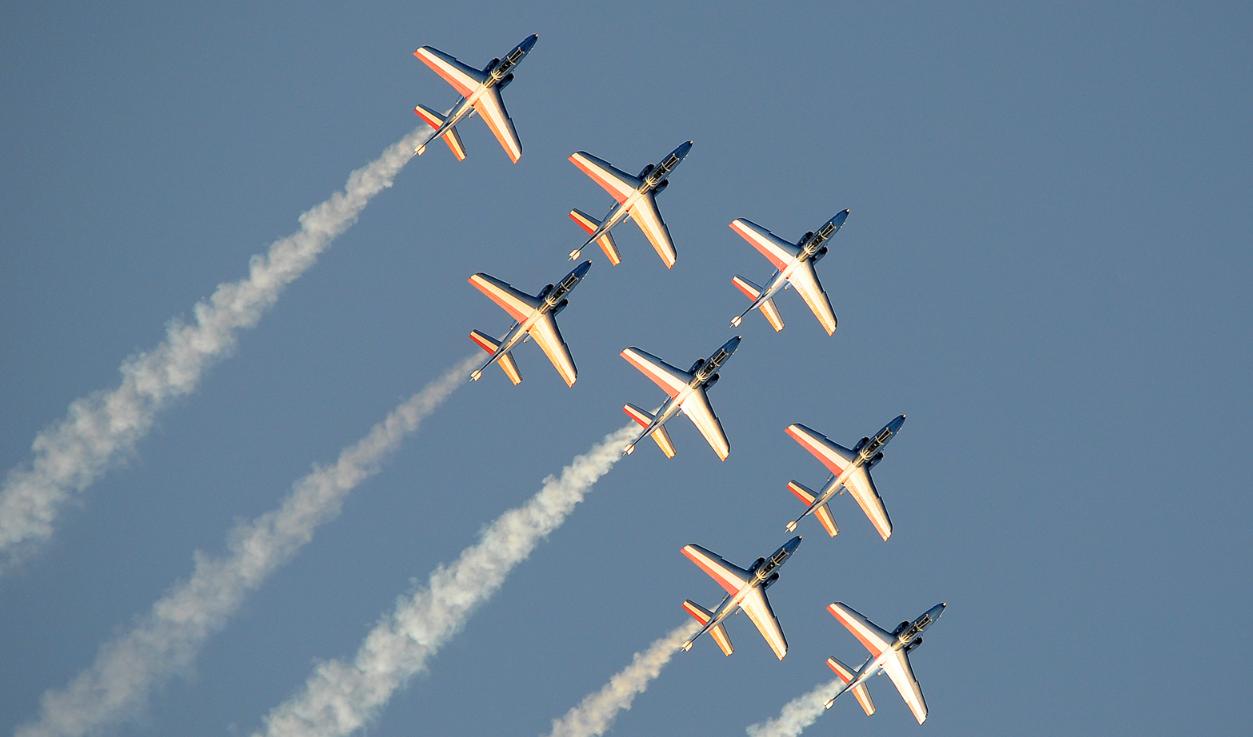
I was in Koksijde, Belgium, yesterday for the Koksijde 65th International Airshow. Been a while since I attended a 'proper' airshow, but I guess with everything happening worldwide 2011 will not be a good year for airshows. A few aircraft would help though. Koksijde especially is a 'difficult' venue at the best of times..crowd line 300 yards from the runway and intermittent sun/strong blustery wind/squally rain in my face all day long. I have never been to a show with so many enthusiasts outside of the airfield either but the best views for photography are along the canal that leads into the town of Veurne as the aircraft come into land. Like an idiot I paid my 40 euros (car and occupants) and went onto the airfield. Highlights were few and far between with upwards of 30 minutes between aircraft in the sky - interesting passes were flown by Belgian AF F-16s and an Airbus A330 (?) and a DC-3, C-130 combo. The rest ranged from good to average to eminently forgettable, aside from the usual Patrouille de France and the Red Arrows especially, who were magnificent, drawing applause all through their display, even if their commentator did refer to the Belgian flag colours as being red/white/blue ...(!!!) ....the USAAF Tbirds were rather tame by comparison and not worth the long wait - they didn't fly until 20h15 (sorry guys!) . Guess it didn't help that I was cold/tired/wet/sunburnt by that time... as usual click on the images for a closer view. More pics to follow some time soon and a photo feature on the Cambrai Tiger meet to come..


Tuesday, 14 June 2011

Republic XR-12 Rainbow

New from Speciality Press, authored by Mike Machat

Still the fastest multi-engine piston aircraft ever flown, the Republic XR-12 and its competitor, the Hughes XF-11, were well ahead of their time in 1946. Envisioned as a long-range photo-reconnaissance aircraft with a top speed of more than 450 mph, the Republic XR-12 also offered near jet-like performance for the world's airlines with a 44-passenger commercial version named the Rainbow. Using original Republic photos, data, and artwork, the author reveals never-before-published information about the Rainbow airliner. While the clear emphasis of this book is on the Republic airplane, the Hughes XF-11 is also covered and compared in its role as a twin-engine competitor to the more advanced four-engine Republic airplane. Although the XR-12 and XF-11 were among the most elegant-looking aircraft ever built, the Rainbow was considered to be Republic chief designer Alexander Kartveli's ultimate masterpiece. Conversely, the more cantankerous XF-11 almost took the life of its designer and chief test pilot, Howard Hughes.


Saturday, 11 June 2011

The best of youtube's ...LOW PASSES !!

A single click to view here

The " low pass" as it is known couples two kinds of terror rather neatly: your rather understandable fear of flying and the rather less likely fear of being hit by a low flying aircraft. Even as an 'enthusiast' - and ex-AF dispatcher - aircraft are scary at the best of times. Multi-tonne tubes of metal and highly flammable petrol that just hang in sky  - and just as easily fall out of it ! Most flight is so effortless planes barely look believable when you see one right up there in the blue sky, but when you see an aircraft near the ground at high speed there's something uncanny and fascinating about it. Aircraft are most usually near to the ground having just taken off or coming in to land - not always so exciting. But the the low pass is. Here's some of the best/ most terrifying low passes I could find on youtube. You'll duck..guaranteed!


Tuesday, 3 May 2011

Javelin, Arrow, Canberra - a selection of images released by the MoD/ RAF, Navy, aircraft manufacturers and agencies for media use

A selection of images released by the MoD/ RAF, Navy, aircraft manufacturers and agencies for media use


Air-to-air shot of Javelin Mk4   a/c XA755, Meteor NF14 a/c WS724 and Gladiator  K8032 in formation at  184mph - the fastest the poor old Gladiator could manage. The Javelin and Meteor in this photo were scrapped in 1963 and 1962 --the Gladiator lives on at Shuttleworth.   Image dated 21 July 1959


Saunders-Roe A1 in civilian markings G-12-1 moored on the River Thames by the Houses of Parliament. She had been flown in  test pilot Geoffrey Tyson for British Gas Turbine week as part of the Festival of Britain. By this time her days were numbered as the idea of a flying-boat jet fighter may have seemed a good idea in 1944 - by the early 1950's it was outmoded.  Image dated June 17th 1951.


Air-to-ship shot of a Buccaneer S1 (possibly XK932?) 121/R of 801 Squadron Fleet Air Arm being catapaulted off the end of HMS Ark Royal. Image dated March 20th 1963


Javelin prints from the 1950s. From bottom left to right; Ground to ground shot of a Javelin Mk8 (a/c unkown) taking off. Image dated 1958

Ground to ground shot of Javelin FAW1 (a/c XA571) with flight crew after delivery to RAF. Crews pictured ar Gloster test pilots Peter Varley and Peter Scott with navigator Bob Jefferies. (Image dated Jan 26th 1956)

Ground to ground shot of 9 Javelin FAW1's at the makers test airfield of Moreton Valence awaiting delivery to the RAF. Two a/c closest to camera are XA552 (destroyed on gunnery ranges) and XA553 (now in S Africa on static display) (Image dated Sept 3rd 1955)

Air-to-air shot of five Javelins in formation for the first time. a/c closest to camera is XA544. Image dated Jan 13th 1955 .

Ground shot of legendary fighter and test pilot Neville Duke and a Hawker Hunter T7 (possibly a/c XL586) Image dated July  21st 1976.


Air to air shot of Canberra T4 in one-off non operational red and white livery over Rutland celebrating 21 years of the Canberra. a/c is WE192 and pilots are grp Capt Kingshott O.C, RAF Cottesmore and Sqd Ldr D Merriman O.C. 231 OCU. Sadly all that's left of a/c now is the cockpit section at Blyth Valley Aviation Collection. Image dated May 5th 1973


Air-to-ship shot of a Phantom (a/c unknown) landing - or as the arrestor hook isn't down, doing a touch and go on HMS Eagle. Image dated 1969
 
The Avro Arrow a revolutionary jet interceptor, designed and built by the A.V. Roe Aircraft company of Canada. The Arrow was a plane of firsts : fly by wire, computer control, integral missile system and capable of MACH 2+. So naturally the idea was scrapped in 1959! All Arrows were destroyed.
Ground shot of Avro Arrow RL201


Avro Lancaster in French Naval Air arm colours. The a/c was one of 54 supplied to the French as general maritime reconnaissance aircraft. Image dated January 24th 1952